Surlyn Skin Film for Food: When Ionomer Earns Its Place in VSP
News 2026-11-25
Most buyers specify ionomer for its clarity. The decisive benefit is quieter: what happens at the seal bar and over a sharp product edge. Choose Surlyn skin film for food on that basis and the structure follows more logically. An ionomer sealant tolerates a contaminated flange, holds hot tack as the web leaves the jaws and drapes without splitting — properties a clear but brittle web cannot offer. This guide is for the technically literate buyer deciding which resin goes into the seal: the chemistry, the figures worth requesting, the trade-offs against PETG, PE and EVOH, and a rule for when the cost is justified.
Key takeaways
- Ionic cross-links give ionomer toughness at room temperature and dissociate on heating, producing a wide seal window: 100–160 °C in university teaching material, 90–130 °C for one 8150 grade.
- Teaching material puts seal strength at about 10× PE/EVA and tensile strength above 2× LDPE; an 8150 listing gives haze of 1.3% and transmission of 92–94%.
- Ionomer seals and toughens; EVOH supplies the oxygen barrier in a coextruded web.
- FDA 21 CFR 177.1330(a) permits ionomeric resins in food contact subject to extractive limits of 0.5 mg/in², or 0.70 mg/in² for fatty foods in films of 2 mil or less.
What Ionomer Film Actually Is
Surlyn is the trade name Dow, originally DuPont, gave to ethylene–methacrylic acid copolymers partially neutralised with sodium or zinc ions. Ionic cross-links between the acid groups give the polymer room-temperature strength; they dissociate on heating, so it processes like a thermoplastic. That reversible network is why one resin can be both tough and sealable.
The US Food and Drug Administration’s 21 CFR 177.1330(a) permits these resins in food contact when extractive limits are met. Paragraph (c) caps net acidified chloroform-soluble extractives at 0.5 mg per square inch of food-contact surface; paragraph (d) sets 0.70 mg/in² for fatty foods in films of 2 mil or less, using n-heptane extraction. DuPont’s 9721 and 1605 data sheets state compliance with 21 CFR 177.1330(a), subject to those limits.
European importers also ask for a declaration under Regulation (EU) No 10/2011. Request it for the specific grade and check the extractive conditions stated on it. Catalogues may call the same construction vsp film surlyn or vsp film ionomer; both point to the ionomer layer doing the sealing work.
The Heat-Seal Window Is the Real Reason to Specify Ionomer
At equal seal temperature, packaging-materials teaching material puts ionomer seal strength at roughly ten times that of PE or EVA. The quoted window runs from 100 to 160 °C; a Dow Surlyn 8150 grade list narrows its own seal range to 90–130 °C and thermoforming to 120–150 °C. Different grades, different numbers — which is why a grade-specific curve should be requested.
A wide window buys line tolerance. Temperature drift across a multi-lane seal bar, residue on the flange or a shorter dwell all eat into a narrow one. Hot tack means the seal holds while still warm, so the web does not peel back as the tray leaves the jaws; converters notice this as fewer stopped cycles.
When comparing Surlyn skin film for food with a polyethylene alternative, ask for seal-initiation temperature, the usable plateau, hot-tack strength and test conditions. A figure without pressure, dwell and substrate is close to useless. Note the ceiling too: normal service temperature should stay below 80 °C, so warm distribution briefs need a different conversation.
Puncture Resistance and Forming: The Second-Skin Effect
Deep-draw VSP asks a web to become the shape of the product — stretch into corners, hug a contour and stay in contact after the vacuum pulls down. The Sterile Barrier Association lists ionomer as a strong optics-and-forming option with only moderate abrasion resistance.
Low-temperature toughness matters: the 8150 listing reports brittleness below −76 °C and a grade sheet gives elongation of at least 450% under ASTM D638.
Robertson’s account of vacuum packaging notes that early VSP used an ionomer film soft enough to drape over sharp objects without puncturing. The mechanism has not changed; only the layer structures around it have.
DuPont’s own Surlyn literature describes a processed-meat programme where top and bottom web gauge fell by more than 30% while stiffness was retained, with about 4% direct raw-material saving and a further 4% through reduced DSD fees. A published example, not a promise for another line: toughness can be spent on downgauging.
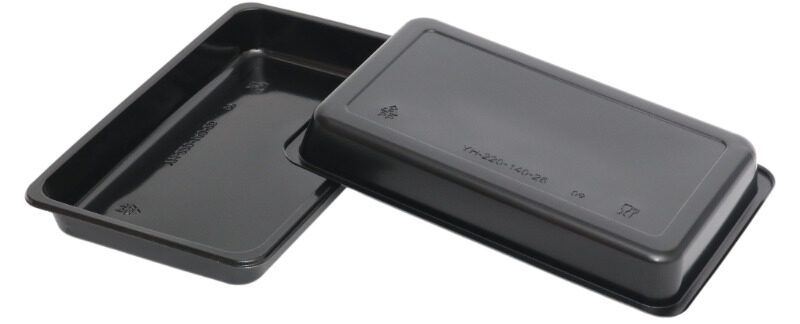
Stress concentrates at the point of deepest draw. Inspect formed samples from your own tooling after a distribution cycle; our note on compatible food trays covers the flange interface.
Clarity, Gloss and Oil/Grease Resistance
Clarity is the property buyers notice first. The ionic structure disrupts regular chain packing, suppressing crystallinity and reducing haze. A published Surlyn 8150 listing gives haze of 1.3% at 0.25 in and light transmission of 92–94% to ASTM D1003; grade sheets put density at 0.940–0.950 g/cm³ with a melt peak of 92–99 °C under ASTM D3417.
Oil and grease resistance follow from the same chemistry. Fatty products do not soften the surface the way they can with some polyolefins, and the seal stays clean. This is the limited sense in which surlyn film for meat packaging appears in catalogues: bone-in and fatty foods are cited as illustrations of that toughness, not as a cut-by-cut specification.
Be honest about the ceiling: service temperature should not exceed 80 °C and moisture barrier is poorer than polyethylene.
Surlyn vs PETG vs PE vs EVOH: Where Each Resin Wins
Four resin families dominate VSP discussions, and confusion comes from judging them against one checklist. They do different jobs. When a buyer shortlists Surlyn skin film for food, the useful test is whether the failure sits at the seal or in the barrier.
| Resin | Where it wins | Main limitation | Best role |
|---|---|---|---|
| Ionomer | Seal strength, hot tack, puncture, optics | Near 80 °C ceiling; weaker moisture barrier than PE; higher cost | Sealant and toughness layer |
| PETG | Clear, tough, easy to thermoform | Not the primary oxygen barrier | Main forming web for chilled display |
| PE | Good water-vapour barrier, flexible cold | Lower seal strength and clarity than ionomer | Structural and moisture layer |
| EVOH | Excellent gas barrier except at high humidity | Moisture-sensitive; not a sealant | Thin core in coextrusion |
Read it as a division of labour. A high barrier skin film food brief is usually an EVOH-core brief; a clear, well-sealed pack is usually an ionomer-seal brief. The useful EVOH skin film for food question is which layer EVOH should occupy: it belongs in the core, and treating it as a sealant is an expensive mistake.
US converters make the same point: ionomer is chosen when high clarity and high strength are needed together, while low-density polyethylene skin poly forces a choice between a strength grade and a clarity grade.
Multilayer Structures: Ionomer as the Sealant Layer
Forming depth comes from the web, oxygen protection from a barrier core, closure from the sealant. A coextruded skin film for food puts each job in a separate layer.
A chilled structure might read PETG / tie / EVOH / tie / ionomer: PETG gives a predictable forming window, EVOH the gas barrier, ionomer the tray seal and point-load absorption. The Sterile Barrier Association notes EVOH loses much of its gas-barrier advantage at very high humidity, so it is buried between moisture-resistant layers.
Specifying Surlyn skin film for food in a coextrusion means deciding where the ionomer sits — at the seal side, never as the barrier core. This is where vsp film surlyn and vsp film ionomer become a structural decision. Our Surlyn-based skin film structures are built around that sequence rather than a single headline gauge.
When Ionomer Earns Its Place — and When Another Resin Wins
Specify an ionomer sealant when the product is irregular or sharp-edged, the pack travels cold, a leaker would be expensive and the flange is imperfect. High-value fish and ready meals with bone fit. A few microns of ionomer are cheaper than a rejected pallet.
Skip it when cost, very high humidity or oxygen barrier alone dominates. A regular product on a short chilled route may not repay the premium; a high-barrier EVOH structure with a conventional PE seal can do the job for less.
Do not let the material decision absorb the supplier decision. Once the layer build is settled, confirm roll dimensions, documentation and trial terms with the partner you choose. Our short working with a film roll supplier guide sets out what to ask; it is general sourcing guidance, not a product-family recommendation.
Is ionomer-based skin film compliant with food-contact regulations?
Yes, when the specific grade meets the applicable limits. In the United States, 21 CFR 177.1330(a) covers ethylene–methacrylic acid ionomers and their sodium or zinc partial salts, with extractive ceilings in paragraphs (c) and (d). In Europe, importers normally request a declaration under Regulation (EU) No 10/2011. Ask for the document covering the grade you buy, not the family in general.
Does ionomer replace EVOH as the oxygen barrier?
No. Ionomer’s gas barrier is better than polyethylene’s but far below EVOH’s. In a coextruded web it seals and toughens while a thin EVOH core controls oxygen transmission. Swapping one for the other yields a pack that looks fine and fails on shelf life.
Will an ionomer web run on a standard VSP machine?
Generally yes, provided forming and sealing settings fall inside the grade’s stated windows. Confirm against your tray material, forming depth and machine cycle rather than assuming a universal setting; a sample trial on your own tooling is the only reliable check.
Material selection and supplier selection are separate jobs. A seal that fails through contamination or a sharp edge is a material problem; a late roll is a supplier problem. Ionomer buys a wide seal window, hot tack, puncture tolerance and clarity; it does not buy oxygen barrier, unlimited heat or the lowest cost. When the product is irregular, cold and valuable, that trade is usually worth making.
Tell our team the product shape, tray material and the failure you are trying to prevent; Youhe will return a layer build with the sealant stated explicitly. The failure mode and the tray material tell us where the web is weakest and what it has to seal to.