PE Skin Film Manufacturer Guide: Flexible, Frozen-Ready, Bone-In VSP Structures
News 2026-11-24
A film that turns brittle at -18°C, or a bone that finds a thin spot and lets purge escape in transit — those are the failures a PE skin film manufacturer gets called about. The answer is rarely a single “stronger” film; it is a layer structure chosen for the product, the tray and the cold chain. This guide decodes the structures buyers actually meet: PE/EVOH/PE, PE/Surlyn/PE, PE/EVOH/EVA and 11-layer coextrusion. You will see what elongation and OTR figures mean in practice, where bone-in and shellfish programmes need extra margin, and how to specify a sample that survives your line.
Key takeaways
- Structure is the spec: PE/EVOH/PE for high barrier, PE/Surlyn/PE for standard barrier, PE/EVOH/EVA for a modified seal layer.
- Published benchmarks include elongation MD/TD ≥400% and OTR ≤2 cc/m²·24h for high-barrier coextruded film.
- For bones and shells, verify on the real product: point-load and seal-integrity trials beat catalogue figures.
What Is PE Skin Film (and How It Differs from PETG/PVC)
PE skin film is a polyethylene top web for vacuum skin packaging, usually coextruded rather than monolayer. Its identity is flexibility: it stretches over irregular products, seals at relatively low temperatures, resists moisture and stays workable in chilled and frozen distribution.
That is why buyers reach for it first with fresh or frozen protein, bone-in cuts and seafood with shells. Other film families have their own strengths; the point here is narrow. PE is chosen when the pack must absorb movement and sharp geometry without losing its seal.
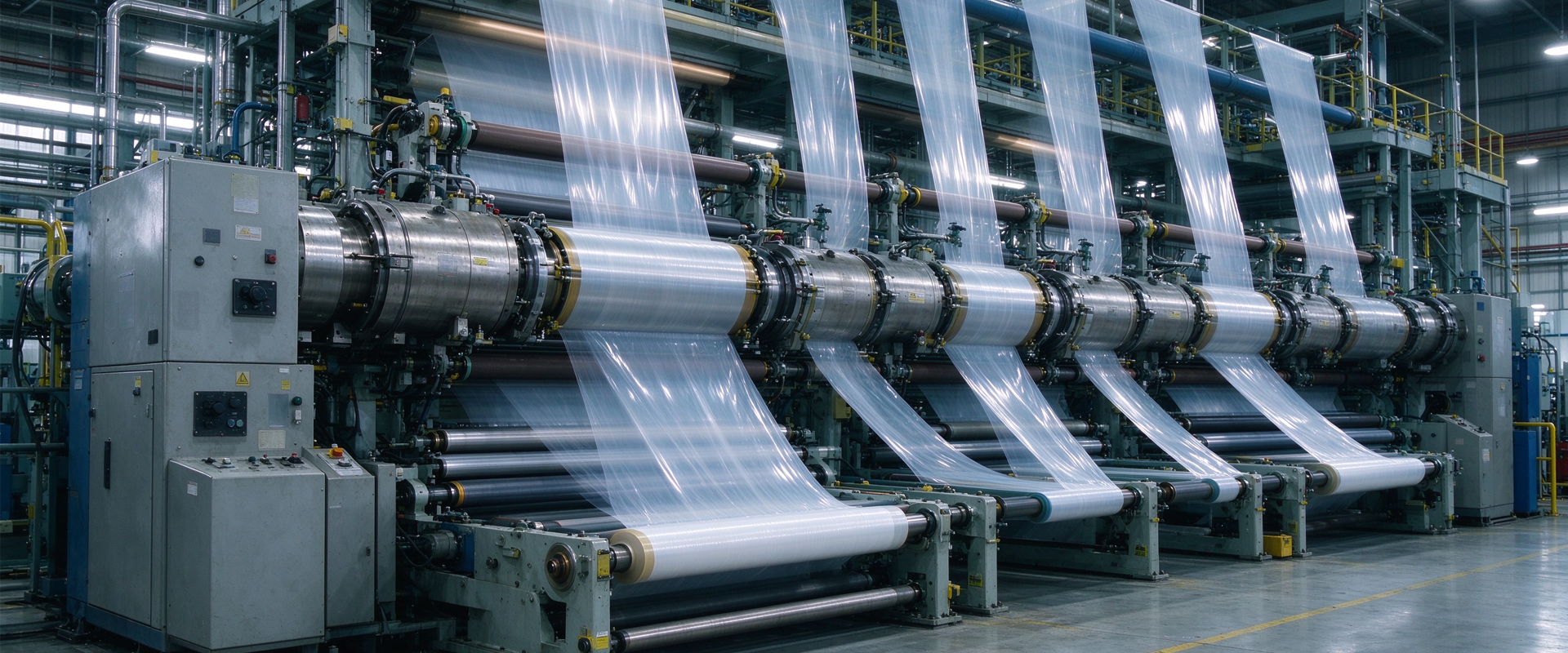
A monolayer web cannot deliver that combination. The performance comes from a stack of layers — structural PE, tie, barrier, tie and seal — each with a separate job.
Why Flexibility and Low-Temperature Performance Matter for Food
Cold chain is where film claims get tested. Chilled distribution already puts a web through condensation, temperature cycling and stacking pressure. Deep-freeze adds a harder question: does the film stay flexible enough to keep gripping the tray?
A stiff or brittle film fails in two ways. It can crack or whiten at the draw, and it can lose contact with the product as the pack flexes, leaving purge to move freely. Freezer burn and dehydration follow when the film no longer locks the surface. Suppliers of frozen VSP film describe freeze-stable adhesion and no tray coating as the practical answer.
For a processor, this is an economic point as much as a visual one. Rejects after transport, leaked purge and shortened shelf life all cost more than a film specified correctly at the start. Flexibility is reliability here, not softness — and it is the first property a PE skin film manufacturer should specify for a frozen line.
Multilayer Structures Decoded: PE/EVOH/PE, PE/Surlyn/PE, PE/EVOH/EVA
Read a structure from outside in. The outer PE layer provides stiffness and moisture resistance; tie layers bond it to EVOH, the oxygen barrier; the inner seal layer closes to the tray flange. Change any one of those and the pack changes.
Three structures cover most briefs. HSQY publishes PE/EVOH/PE high-barrier skin film for fresh and frozen foods, with EVOH identified as the oxygen barrier and thickness, width and OTR customised. Lander distinguishes high-barrier PE/EVOH/PE from standard PE/Surlyn/PE and also offers a breathable high-OTR variant; Tipack lists PE/EVOH/EVA VSP film roll for fresh meat, fruit and seafood; and CHEMPEOPLE describes an 11-layer coextruded film with OTR ≤2 cc/m²·24h in an 80–150 μm gauge range.
Barrier choice follows the food. High-barrier EVOH suits chilled red meat where colour and shelf life matter; permeable variants suit some frozen applications and fresh white fish that need oxygen transmission rather than exclusion. Seal layer choice follows the tray: EVA-modified layers are used for PE trays and clean peel, while ionomer (Surlyn) layers are chosen for hot-tack and puncture resistance.
| Structure | Barrier and seal logic | Typical fit |
|---|---|---|
| PE/EVOH/PE | EVOH oxygen core, PE seal | Fresh and frozen protein, high barrier |
| PE/Surlyn/PE | Ionomer seal, standard barrier | General VSP, hot-tack focus |
| PE/EVOH/EVA | EVA-modified seal layer | PE trays, clean peel |
| 11-layer coextrusion | Tuned barrier and seal balance | Bone-in, frozen, long-haul |
Our multilayer PE skin film rolls are specified around the tray and cold-chain profile rather than a generic gauge.
Puncture Resistance for Bone-In Cuts and Seafood
Bone and shell are point loads. A film can resist a broad impact and still be cut where a rib or claw concentrates force at the point of deepest draw.
Published figures give a sense of scale. CHEMPEOPLE cites elongation MD/TD ≥400% for its coextruded skin film, while Lander describes stretch up to about 300%. Both are used for bone-in steaks, ribeyes and sharp-shelled seafood, with freeze-stable adhesion and no reliance on a tray coating. Gauge commonly sits in the 80–150 μm band.
Numbers are a starting point, not proof. Run point-load and seal-integrity trials with your actual product: a lamb rack and a whole crustacean present very different geometries. Inspect corners and thin spots after forming, then repeat the check after a frozen distribution cycle.
Application Examples: Fresh Meat, Frozen Food and Seafood
Fresh chilled beef, pork and poultry use the barrier layer to protect colour and shelf life while the clear web keeps the product visible. Frozen blocks and long-haul programmes need freeze-stable adhesion so the film does not delaminate or loosen at -18°C.
Seafood is the hardest test. Shells and fins are sharp, drip must stay put, and the pack often travels chilled or frozen. Suppliers cite puncture tolerance and drip retention together for this reason. For mixed protein ranges, how to select a skin-pack partner by food type is worth reading before you reuse a meat film for shellfish.
Ready meals and cheese are adjacent fits where seal reliability matters more than extreme puncture resistance.
How to Choose a PE Skin Film Manufacturer
Five checks keep the specification honest.
Confirm coextrusion capability and layer count in-house, and require those figures in writing. Ask the supplier to match the seal layer to your tray material — PE, PP, PET or PS all behave differently — and to avoid tray coatings where the structure allows.
Request OTR, elongation and migration data plus food-contact certification relevant to your market (FDA, EU statements, FSSC-class systems). Fix the customisation scope in writing: thickness, width, barrier level, seal layer, print and cold-chain rating.
Then run a sample on your own line. A PE skin film manufacturer who will trial on your tray understands that the film is part of a system; one who only posts numbers does not. Combine that with tray-compatible skin packaging so film and flange are developed together.
Structure Selection as a Development Task
A PE skin film manufacturer starts with the layer build and works outward from there. Tell us the product, tray material and dimensions, sealing machine, target shelf life and cold-chain profile. We return a structure-matched sample and a specification sheet stating layer build, gauge, OTR and seal layer.
OEM/ODM programmes can adjust barrier level, print and width where volume justifies it. Factory-direct supply keeps those decisions close to the extrusion line, and in-stock lines can be dispatched within 24 hours. Ask for retained samples and lot traceability as part of the handoff — they are what make a second order match the first.
What PE skin film structure is best for frozen food?
High-barrier PE/EVOH/PE is common for frozen protein, but some frozen programmes use permeable, high-OTR variants without EVOH. Choose by whether the food needs oxygen exclusion and by the temperature profile.
Can PE skin film handle bone-in cuts and sharp shells?
Yes, when elongation, gauge and seal layer are matched to the geometry. CHEMPEOPLE cites bone-in cuts and whole crustaceans for its 11-layer film; verify with your own point-load trial.
How is PE skin film different from PETG skin film?
PE is flexible, seal-friendly and strong in cold-chain and puncture applications; it is usually coextruded. PETG is chosen mainly for high clarity and a clean forming window in chilled presentation.
Structure is the spec. Flexibility, an EVOH barrier where oxygen matters, a seal layer matched to the tray and enough elongation for bones and shells decide whether a pack survives the cold chain. Vetting a PE skin film manufacturer means checking coextrusion capability, data for OTR and elongation, cold-chain rating and a trial on your own line.
Send the product, tray material, sealing machine and cold-chain profile to Youhe and we will come back with a layer build matched to your tray — OTR, elongation and seal layer stated on the sheet. If the pack has failed at -18°C before, tell us how; that detail changes the structure we recommend.